Ableton versus FL Studio for House Producers
A house record can begin with one kick drum, a piano chord that catches at the heart, or a vocal fragment rescued from an old idea. The question of Ableton versus FL Studio matters because the software beneath that first spark shapes how quickly it becomes a finished track. Both can make music built for dark rooms, raised hands and the long release of a proper piano breakdown. They simply invite you into the process in different ways.
For producers drawn to the emotional lift of late-80s and 90s house, the best choice is rarely about which DAW has the biggest feature list. It is about feel. Do you want to build from a groove, twist samples in real time and let an arrangement grow through performance? Or do you hear the whole track as patterns first: drums, bass, keys and hooks locking together with precise, infectious momentum?
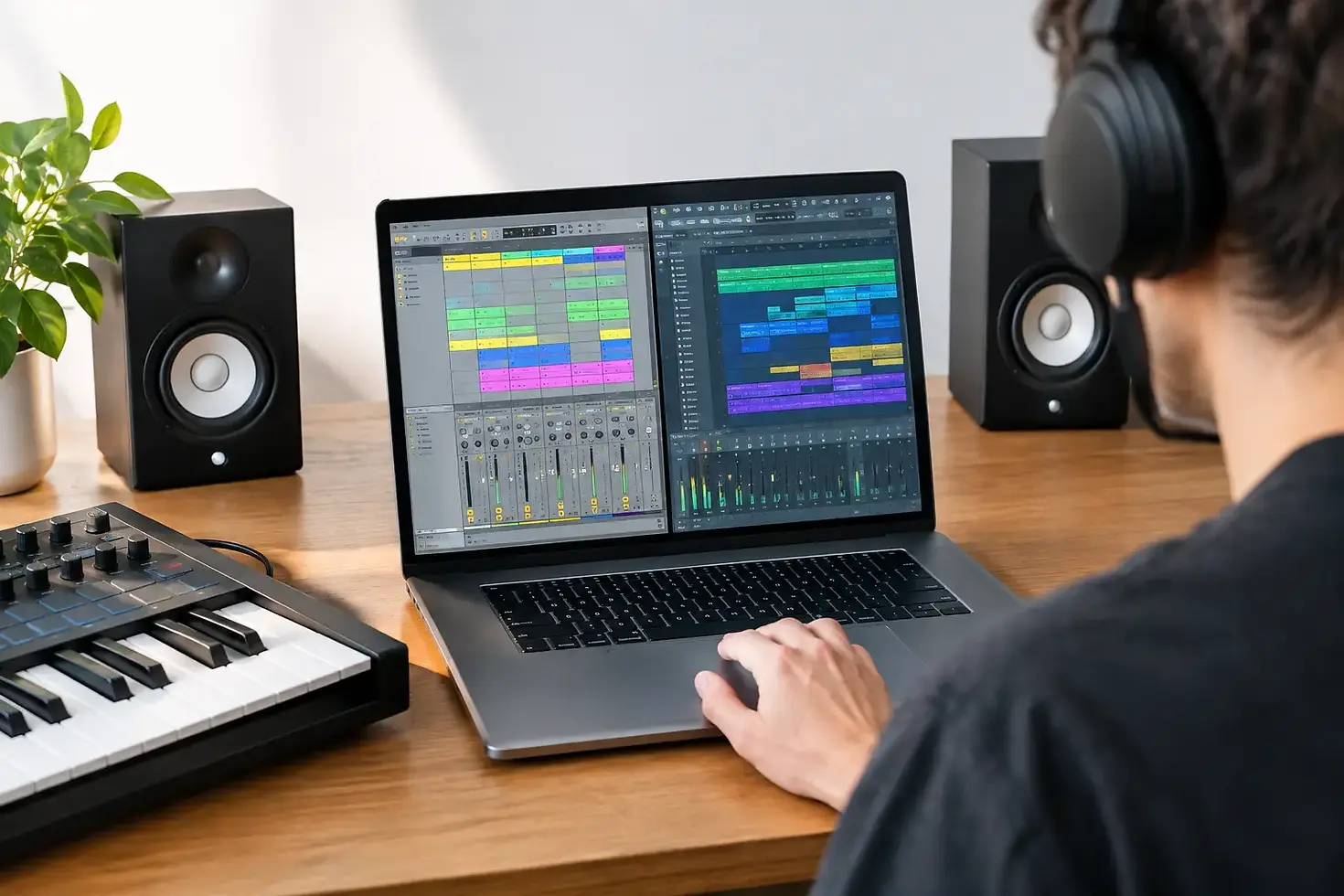
Ableton versus FL Studio: the central difference
Ableton Live feels designed around movement. Its Session View lets you launch drum patterns, basslines, chord stabs and vocal cuts as separate clips, then test combinations without committing to a linear timeline. It is a natural home for anyone who thinks like a DJ, a live performer or a producer chasing a happy accident at two in the morning.
FL Studio feels more like an exceptionally fast musical sketchbook, particularly when rhythm and melody are leading the idea. Its Channel Rack and Piano Roll make it easy to build detailed drum patterns, programme rolling percussion and write chord progressions with confidence. If you enjoy seeing the architecture of a groove clearly, then refining every note until the swing lands just right, FL Studio has a very immediate appeal.
Neither approach is more authentic. The Haçienda era was never about one method. It was about energy, selection, instinct and the willingness to make a room feel something. Your DAW should support that instinct rather than turn it into admin.
Why Ableton Live suits performance-led house
Ableton is particularly strong when sampling is central to your sound. Dropping a dusty disco loop, a spoken vocal phrase or a fragment of piano into Simpler, then slicing and reworking it, is fast and tactile. Warping makes it easy to bring older material into a modern tempo while preserving its character. That matters when the human push and pull of a sample is part of the magic.
Session View is Ableton’s defining advantage. You can prepare several kick patterns, alternate bassline ideas and different breakdown chords, then launch them against each other as though you are building a DJ set. Instead of staring at a blank arrangement, you can find the moments that create tension and release by playing them.
This workflow suits uplifting house brilliantly. A four-bar organ loop might feel fine on its own, but it takes on a different life when you bring in a tambourine, pull the kick for half a phrase, then return with a vocal hook. Ableton makes those arrangement decisions feel physical. You are responding to the music, not only drawing blocks across a screen.
Its built-in audio effects also encourage experimentation. Filters, delays, reverbs and modulation can be automated quickly, while racks allow multiple effects and controls to be grouped together. A single macro can open a filter, increase reverb and introduce delay feedback as a breakdown rises. That is not a replacement for taste, but it keeps the technical side out of the way of the emotional decision.
There is a trade-off. Ableton’s Piano Roll is capable, yet many producers find it less inviting than FL Studio’s for deep MIDI programming. If your tracks begin with elaborate chord voicings, melodic counter-lines or tightly programmed percussion, the workflow can feel less immediate. Live also rewards learning its way of thinking. Session View is powerful precisely because it is not simply a traditional tape-style arrangement window.
Ableton is likely your fit if...
Ableton makes sense if you want to sample, resample and manipulate audio as part of writing. It is also a strong choice if you perform live, want to build tracks from looping sections, or prefer to discover an arrangement through jamming. For a producer who hears house music as a conversation between records, machines and the room, that freedom can be inspiring.
Where FL Studio finds its groove
FL Studio has long been admired for drum programming, and that reputation is earned. The step sequencer is wonderfully direct for getting a house rhythm moving: kick, clap, closed hat, open hat, percussion, then the small variations that stop a loop from sounding like a loop. You can get a solid four-to-the-floor foundation running in minutes.
The Piano Roll is one of its greatest strengths. It makes it comfortable to write, edit and experiment with MIDI, whether you are placing classic piano chords, programming a rubbery bassline or creating a melodic synth part that carries the emotion of the record. Chords can be nudged, inverted and revoiced without breaking the flow. For house producers who want warmth and musicality at the centre, that matters.
FL Studio’s pattern-based approach also fits the DNA of dance music. A great house track often depends on a handful of strong elements, each doing its job with conviction. In FL, you can build the kick pattern, make a separate pattern for shakers, then create variations for fills, rides and breakdowns. The Playlist gives you the space to turn those pieces into a full journey once the groove is established.
It is easy to understand why FL Studio appeals to producers who enjoy control. A snare can sit fractionally ahead, a hi-hat can have its velocity reshaped, and a bass note can be shortened until it breathes perfectly around the kick. These details may not be obvious in isolation, but they change how a record moves on a proper system.
The compromise is that FL Studio can encourage pattern perfection before you have tested the wider arc of the track. It is possible to spend an evening polishing eight bars that never develop into a memorable arrangement. Its audio tools are capable, of course, but those who work heavily with found sound and spontaneous resampling may find Ableton more fluid from the first click.
FL Studio is likely your fit if...
Choose FL Studio if your best ideas arrive as beats, basslines, melodies and carefully shaped MIDI. It is especially rewarding if you want a quick route from an idea in your head to a groove you can feel in your chest. For piano-led, vocal house with detailed percussion, its speed can keep the original feeling intact.
Sound quality is not the deciding factor
Both DAWs can produce release-ready music. Neither Ableton nor FL Studio has a built-in “better sound” button, despite the arguments that still circulate in producer circles. The quality comes from your source sounds, arrangement, gain staging, monitoring and decisions. A perfectly chosen kick and bass relationship will say more than any software badge.
The more useful question is whether you can stay in the creative moment. A DAW that feels natural means more finished records, and finished records teach you far more than endlessly comparing plug-ins or watching tutorials. That is true whether you are working with vintage-inspired samples, modern synths or a simple piano and drum machine palette.
Think about the track you want to make
Imagine two starting points. In the first, you have lifted a soulful vocal phrase and want to chop it, pitch it, loop it against a drum break and discover where it belongs. Ableton will probably feel like the more natural partner.
In the second, you can hear the chords already: a bright piano progression, a warm sub-bass and a percussion pattern that needs just enough shuffle to suggest an Ibiza terrace at sunset. FL Studio may get you to that first rush faster.
There are practical factors too. Try the current versions before committing, especially with your own controller, headphones and preferred sample packs. A DAW is a long-term creative space, so notice what happens after the first hour. Are you making music, or are you looking for the right menu?
J-HUG’s world is built on the point where emotion meets melody and nostalgia meets rhythm. Whichever DAW you choose, keep that point in view. Make the groove honest, leave room for the hook to breathe, and choose the tool that keeps you close to the feeling that made you press record in the first place.



Comments